
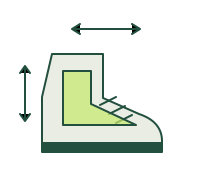
No-show and ankle: for trail runners
A no-show sits below the shoe line; an ankle sock stops at or just above the ankle bone. They suit trail runners and low hikers on clear paths. If the collar rubs your ankle bone, go up a height; if grit gets in, a gaiter closes the gap where a taller sock does not.
Quarter and micro crew: for low hikers and mid boots
A quarter covers the ankle bone, at 5.5 inches heel to cuff at Darn Tough. A micro crew rises a few inches higher, 8.5 inches for Darn Tough men’s and 7.5 for women’s, and clears the collar of most low hikers and many mid boots. Other brands call these heights 1/4 crew, 3/4 crew, mid crew or mini crew.
Crew and boot height: for tall boots
A crew sock rises well above a boot collar: 10.5 inches for Darn Tough men’s crew and 11 for its boot sock. Sealskinz calls its version Mid Length and Icebreaker says Mid Calf. Pick this height when your boots come up over the ankle.
Over-the-calf: for mountaineering boots and gaiters
Over-the-calf socks run up to just below the knee, 17 inches for Darn Tough men’s and 16.25 for women’s. They are for tall, stiff boots, ski boots and long gaiters.
Measure the same way, and check women’s heights
Heel-to-cuff inches start at the back of the heel. Women’s versions are often shorter: Darn Tough’s women’s micro crew is 7.5 inches against 8.5 for men’s. Where a maker prints no inches, compare the height name and try the sock with your shoes.
The same height name, a different cuff at each brand
3 brands print their cuff heights in inches. Darn Tough measures from heel to cuff; Fox River and Wigwam give typical lengths without saying where they measure from. The names match, the inches don’t: a crew is 10.5 in at Darn Tough, 10–12 in at Fox River and 9–12 in or more at Wigwam. Compare the inches with how high your boot collar sits.
| Height | Darn Tough | Fox River | Wigwam |
|---|---|---|---|
| No-show | No Show Hidden / No Show Invisible 2 in, women’s 1.75 in No Show Socks / No Show Tab 3.5 in, women’s 2.75 in | – | No Show 3 in or less Low-Cut 3–4 in |
| Ankle | – | Ankle 3 in | – |
| Quarter | 1/4 (Quarter) 5.5 in Shorty 6 in, women’s 5.75 in | Quarter Crew 5–6 in | Quarter Length 4–5 in |
| Micro crew | Micro Crew 8.5 in, women’s 7.5 in | – | Mid-Crew Length 8 in |
| Crew | Crew 10.5 in, women’s 8.5 in Boot 11 in, women’s 10.5 in | Crew 10–12 in | Crew Length 9–12 in or more Boot Length 12–13 in or more |
| Mid-calf | Mid-Calf 12 in | Mid-Calf 14–15.5 in | – |
| Over-the-calf | Over-the-Calf / Knee High 17 in, women’s 16.25 in | Over-the-Calf 17–19 in | Over-the-Calf Length 15 in or longer |
What this can’t tell you
Published heights are averages across sizes, and boots differ, so the only sure check is the sock and the boot on your leg. Move your ankle and look at where the collar touches.