
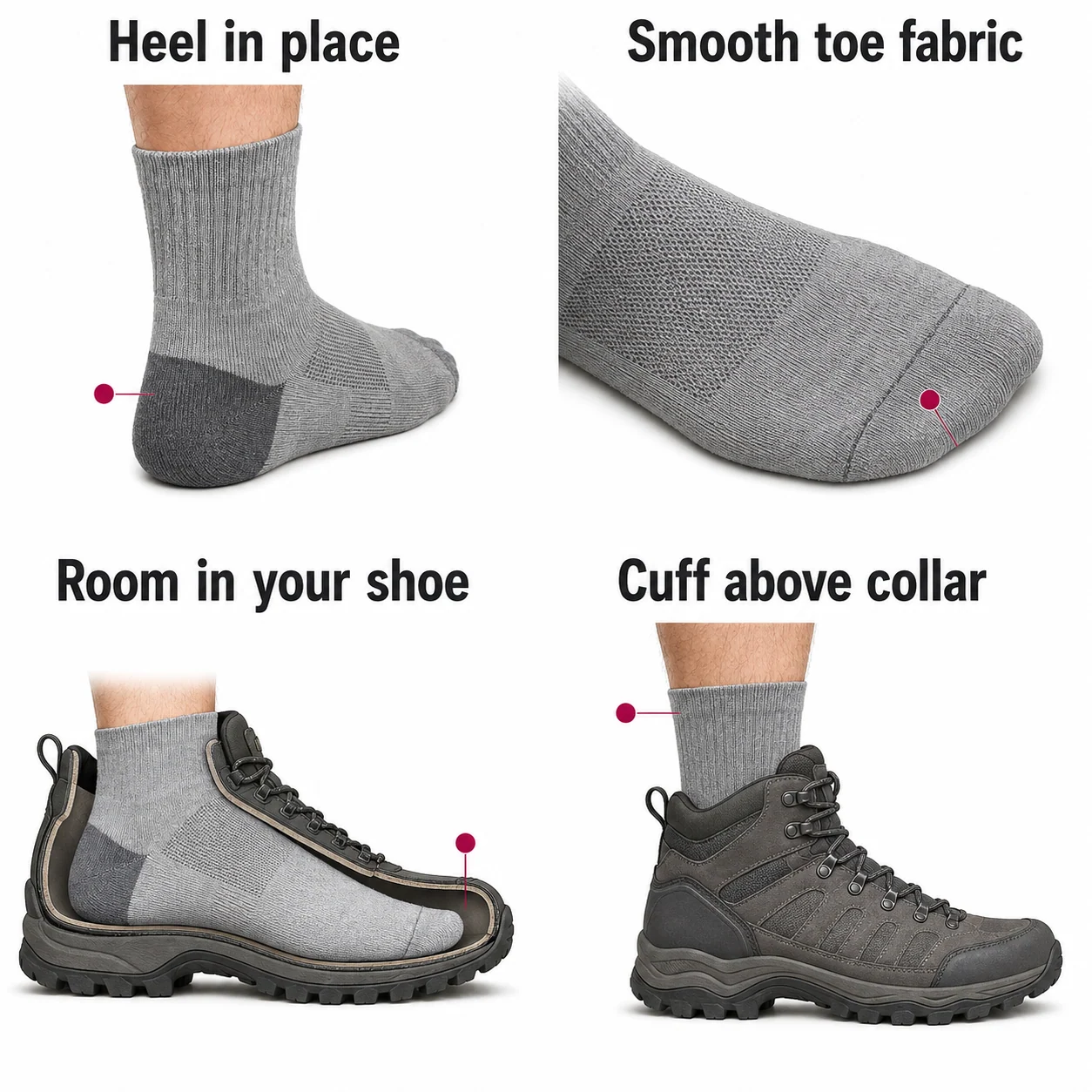
- HeelHeel pocket stays centered on your heel.
- ToesToe fabric lies smooth without pulling or folds.
- Footwear spaceThe complete sock and insole leave room in the shoe.
- CuffSock fabric extends above the rubbing collar.
Rubbing begins → stop, remove grit and folds, re-seat the sock, then recheck the footwear.
Choose the right chart
Use the size of your actual foot in the chart’s published shoe-size system. If you deliberately buy larger hiking shoes for extra space, their label can lead to an oversized sock. Do not subtract a universal half size: the difference depends on the footwear and your foot.
If you only know a length in centimeters, use a maker chart that explicitly accepts that measurement or have your foot sized in the required system. This lookup accepts US, EU and UK shoe-size values; it does not turn a measured length into a universal shoe conversion.
A chart labeled men, women or unisex belongs to a model family. The US men’s and US women’s columns are numbering systems within that chart. Choose the model’s chart first, then the column you know. Changing columns does not change the sock construction.
For example, Darn Tough 1466 uses the men’s/unisex chart; 1903 uses the women’s chart and has a different published cuff height and blend. A shared medium label does not make them interchangeable. At a boundary, follow the exact maker’s advice. The size lookup preserves overlapping ranges and does not average them.
Place the heel before judging the size
Pull the sock on without stretching the cuff up first. Position its heel where your heel sits and smooth any excess fabric under the arch or toes. A heel pocket that stays misplaced is a reason to recheck the size and construction.
Use the actual footwear
Put on both socks with the shoes, insoles and lacing you intend to use. Stand and walk indoors. Check whether the toes have room, the heel remains positioned and the fabric bunches. A different sock changes the fit check; a size-chart match alone cannot confirm it.
Separate padding from available space
If the footwear already feels tight, added cushion or another layer is not a way to make it larger. Start by checking the footwear. If there is spare room, compare where a sock adds fabric rather than assuming its weight label describes a measured thickness.
Check the collar and cuff
The cuff should sit above the contact area you want covered. Compare a published heel-to-cuff measurement with your actual shoe or boot. “Micro crew,” “crew” and “boot” are not uniform measurements across brands.
Repeat the check after moving
Walk indoors long enough to notice whether the sock slips, folds or needs repositioning. Check the retailer’s return conditions before trying it outside or washing it. If a pair feels wrong, adjust the fit decision rather than expecting a material percentage to solve it.
If a warm or rubbing spot appears on a walk, stop and recheck fit, wrinkles, grit and damp socks. The hot-spot prevention guide gives the complete before-trip and on-trail sequence.